Nicholas Winding Refn’s first film in a decade makes up for a weak script with gorgeous production design and a cast committed to the campiness of it all.
Written by Audrey Vieira
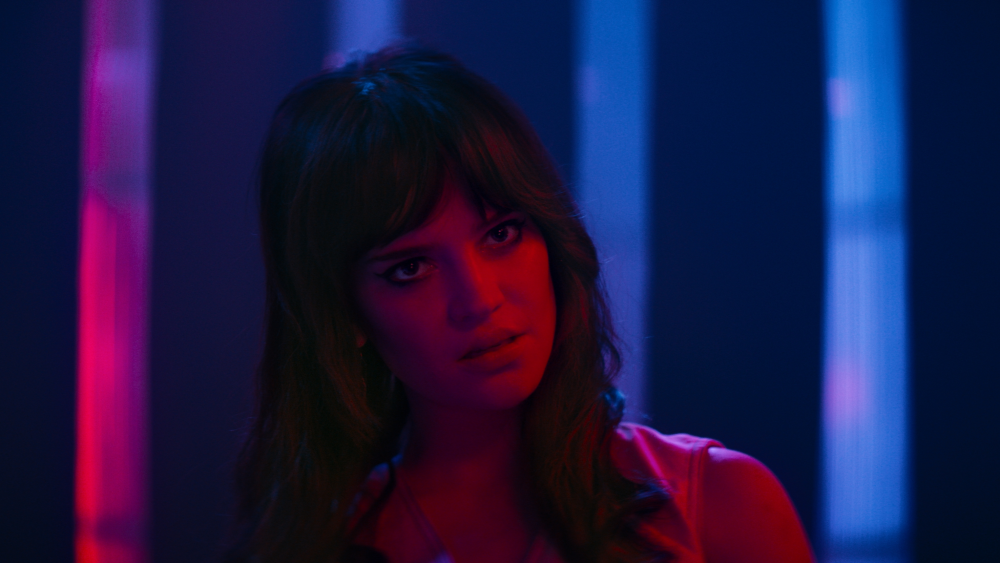
Photo courtesy of Neon
There are two types of bad movies in this world—the kind that are flawed, and the kind that are boring. Her Private Hell, director Nicholas Winding Refn’s first film in a decade, is thankfully only the former. Despite flimsy characterization, at-times cringeworthy dialogue, and a constant feeling that this could have been a perfume commercial, it is an enthralling watch thanks to its talented cast and gorgeous cinematography.
Describing the plot feels like reliving a strange dream moments after waking up. At first, it’s about actress Elle Thunders (Sophie Thatcher) living in a beautiful hotel room with a beautiful circular couch while she’s left alone to film a retro sci-fi action movie with her former best friend Dominique (Havana Rose Liu), whose friendship with Elle soured due to her marriage with Elle’s father, Johnny (Dougray Scott). Johnny leaves Elle alone with Dominique in hopes of getting his two girls to bury the hatchet, but not before delivering some bizarre exposition about the Leather Man. The Leather Man is a demonic figure dressed in leather whose female victims cry out “Daddy!” before he rips their chests open. It is very obvious here that a man wrote and directed this thinking he was making a point about women, only to fall flat into a pit of neon, mist, and misogyny.
There's also a parallel storyline about an American soldier named Private K (Charles Melton), hunting down the city's Yakuza with a set of brass knuckles in hopes of avenging his young missing daughter, whom he failed to save from The Leather Man. It’s definitely the more coherent plot of the two, to the point where it almost feels like a different movie at times. Audiences might have a better time with Her Private Hell if they embrace this dissonance and think of it as two different stories—first the bizarrely captivating story of Elle and Dominique’s toxic, fractured bond, followed by the bloodier revenge quest that is Private K’s arc—but that doesn’t change the fact that these two tales needed a bit more to connect them besides the looming specter of the Leather Man and the overbearing theme of fathers needing to protect their daughters.
To put it bluntly, the writing in Her Private Hell is campy at best and cringeworthy at its worst. Watching women moan “Daddy!” as the Leather Man rips their chests open is awkward the first time it happens and doesn’t improve with further kills. The entire female-led storyline suffers from Winding Refn often alluding to the vague concept of Girl Power, only to pivot back into fetish content territory or shame female characters for the audacity of wanting to be liked.
Wannabe influencer Hunter (Kristen Froseth) is perhaps the greatest victim of this inconsistency. In an uplifting moment with Dominique, Hunter begins the story being encouraged to embrace her individuality, only to gradually become the film’s punching bag as characters detest her desire to be “relatable.” While Hunter is certainly meant to be annoying, Froseth plays her with such wide-eyed innocence that the film’s contempt for her feels cruel, especially when Elle and Dominique gossip about how Hunter’s desperation to be liked makes her “unfuckable” despite her beauty. Instead of highlighting a catty moment between the two female leads, the quip comes across as a writer’s barely disguised grievance.
The dialogue of the film also has its ridiculous moments when it isn’t veering into clearly-written-by-a-man territory, but these aspects are thankfully much more enjoyable. Some of the script’s better sequences involve characters monologuing nonsensical lore drops such as “The airline lost my luggage because of the mist” or “I went down the Leather Man rabbit hole last night” over a beautiful, lush score by Italian composer Pino Donaggio, who is thankfully much better at composing music than Nicholas Winding Refn was at writing the film’s story.
But despite a weak script, Her Private Hell is delightful to look at. Considering so many recent blockbusters suffer from painfully obvious green screens, subpar CGI, or bad lighting, it is refreshing to see the neon lights amidst the city’s darkness. Elle’s hotel room is also a standout with its wide, circular couch and sleek golden beams, which establish the set as both a beautiful getaway for Elle’s fellow co-stars and a hellish gilded cage for Elle herself. These are the dazzling images on a silver screen that Nicole Kidman foretold in her iconic AMC advert. That being said, there are points where the neon lighting becomes too much of a good thing—the strobes of color go from club night vibes to disorienting photosensitivity risk during one sequence near the third act—but it works in the context of the film if viewers know what they're in for.
The ultimate litmus test for whether someone would enjoy Her Private Hell is the nonsense of it all. For example, those who liked the polarizing 2021 horror film Malignant will probably have a great time watching this movie thanks to Charles Melton’s surprisingly fun fight sequences, but those who didn’t enjoy the slow burn it took to get to the action there probably won’t have patience to sit through the near-constant aura farming in between fight scenes. Yet even those empty shots of actors staring moodily into the camera are engaging to watch because everyone in this cast has the aura to pull it off. Sophie Thatcher and Havana Rose Liu have some especially ridiculous dialogue (if the two of them barking and growling at each other, or “speaking wolf,” as one of their characters describes it, even counts as dialogue) yet their commitment to the bit turns that ridiculousness into delightfully campy entertainment.
Her Private Hell will probably be nominated for zero Oscars next year. Still, cinephiles should riot if the Razzies have the audacity to punch down on it. It exists in the purgatory of bad movies that are too good to be written off as “bad movies,” because despite its flaws, it is too entertaining not to give a chance. Not everyone will like what they see, but everyone who thinks they might enjoy it should embrace the madness and watch this dazzling mess of a film.