Interview: Atlas Maior
To commemorate their latest album, Palindromlar, Austin-based jazz quartet Atlas Maior shares how they keep both their community activism and their globally conscious, experimental music alive.
This interview was originally done in November 2025.
Written by Luna Harper
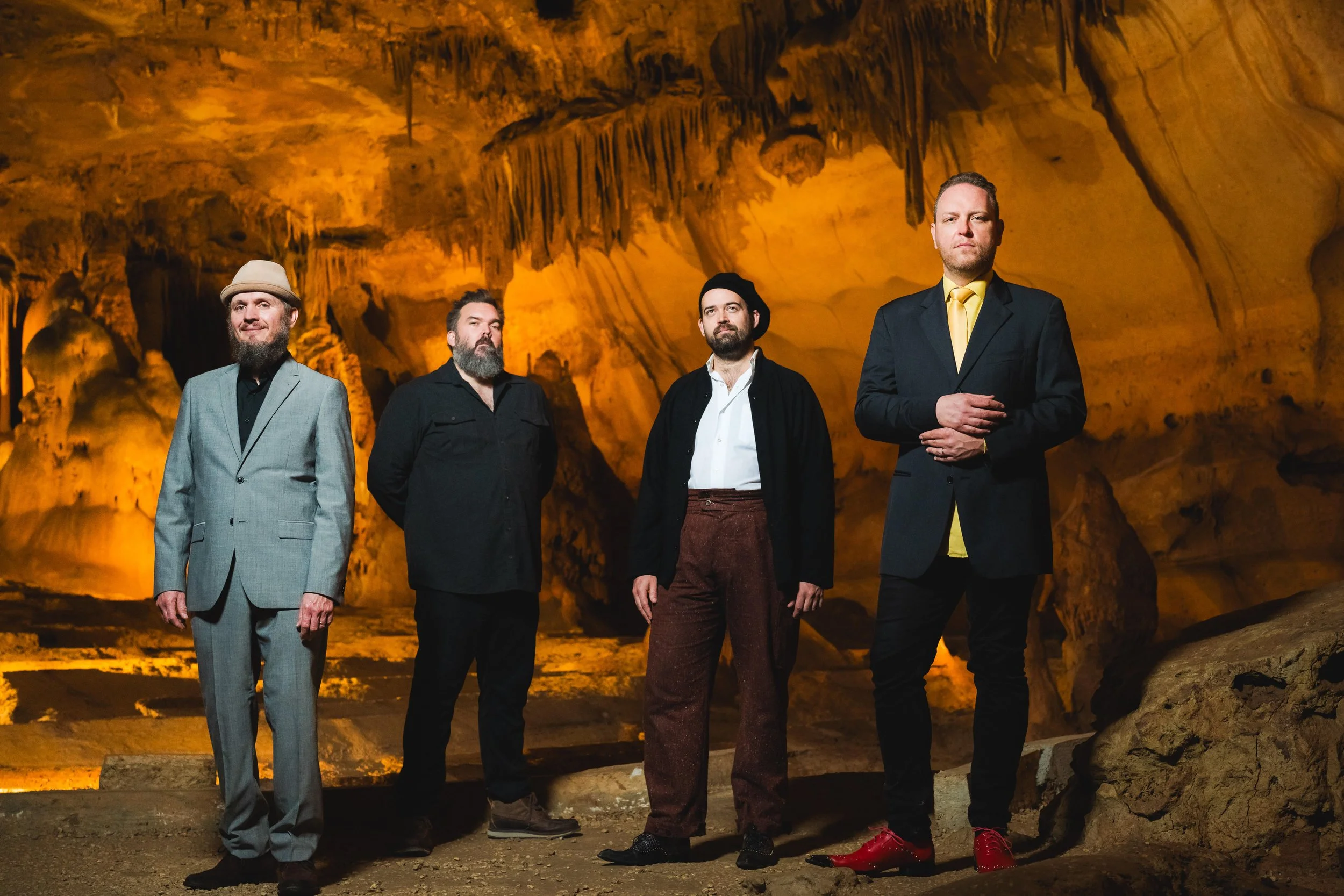
Photo courtesy of Ismael Quintanilla III
For almost two decades, veteran band Atlas Maior has served as Austin’s gateway for international music. The four-piece infuses Middle Eastern traditions, like the maqamat and oud, into their globally conscious, culturally interconnected style of jazz. Luna Harper recently spoke with two band members, Joshua Thomson and Joshua Peters, to learn more about the group’s local activism and their latest record, Palindromlar.
Luna Harper: Tell me more about your beginnings as a band, and how you developed your sound.
Joshua Thomson: Atlas Maior has been active since 2009. I think our recent recording is our seventh album. We work with different world music communities, [but] we do compose original music. We call it American jazz, because that's what it is to us. The term jazz can mean a lot of things. It’s more of a philosophy, in a way. So we are influenced by Middle Eastern music, particularly the Turkish maqamat. They're two different systems that have some similarities. We are influenced by Indian music, North African music, [and] Latin music.
I know that sounds like a lot, but the whole idea is that we create our own sound with certain influences. So it's not like we're consciously trying to push an agenda of one thing over another. And as the band has evolved, [we’ve been] influenced by free improvisation and [its] subtleties. So that's been a theme that has come in over the last couple of years since Josh Peters joined. Peters and I have been playing music together [for] about 10 years now.
Joshua Peters: Holy…yeah.
Thomson: Joshua Peters—I call him Peters—he’s a multi-instrumentalist, a very talented musician, and when I met him, he was playing trumpet and percussion. He still plays trumpet and percussion in different settings, but we had an opening oud position in the band. And this gentleman saw [sic] the moment and took over the oud position. Joshua Peters, would you like to describe what the oud is?
Peters: Oud is probably the oldest stringed instrument in the lute family that we know of. It's been used for thousands of years, and it’s still used today in popular, traditional folk, and classical music throughout the Arabic-speaking world, Turkey, into the Balkans, into Iran and Central Asia—to a smaller degree, but it's still there. It’s a fretless lute with either 11 or 13 strings, typically. They're double coursed. Using that instrument in this setting…it's hard to play oud without evoking maqam, because it's so tied to the instrument and the tradition. If you're an oud player, typically, the first thing you're going to learn is maqam, either Turkish or [Arabic]. If you're coming from the Iranian tradition, then you'd be learning the radif, which is a totally different system. It has similarities, but it's more tied to the Iranian classical tradition and has some of its influence on Hindustani music as well, which is really fascinating when you look at the differences [among] Indian classical traditions.
Peters: A big part of why our sound as an ensemble has that [Middle Eastern] influence pretty upfront is partially the instrumentation. We originally met playing more traditional Arab music in a different group. So that's a big part of the sound with that instrument and with the saxophone, and with the way we use elements of maqam and microtonality. When you hear the sound of the oud, it's very hard to separate it from those traditions, I think.
Listening to your latest album, Palindromlar, you can hear that Middle Eastern music influence. How would you describe maqamat, and how does Western jazz differ from it?
Peters: Maqam is a system that utilizes what in the West you might think of as modes, so different groupings of notes in typically seven or eight pitch sets. But they're not conceptualized at all like how we would think of it in the West. It's more broken up into three and four-note groupings that have a very specific movement. The way that you move inside the maqam is what makes the maqam. So if you just play the scale up and down, it doesn't really evoke anything. But there's a particular way, and there [are] particular notes that have extra weight in the maqam, and those notes you can use to modulate into other maqamat. It's much more based on melody. In the West, a lot of our thinking about musical theory is based on harmony and vertical structures. Maqam is very linear, and it's very much about the movement of the melody within these pitch sets, and how you move [between them].
Peters: The way that we bring that into the jazz world is through the shared improvisational philosophies between different [styles of music]. Like in maqam music, there is a form called taqsim, which is usually a rhythmically free solo improvisation that takes you through a maqam. [The improvisation] explores the maqam—maybe you modulate into a few others and come back at the end. So that's something that we bring into our setting. It's also a lot easier given our instrumentation, because we don't have a harmonic instrument in the band. We have saxophone, bass, we have drums and percussion, and we have oud.
So we can imply harmony, but we don't ever really have what you would think of in a typical jazz setting of a piano or a guitar, or something actually playing the harmony outright. So it gives us a lot of freedom to explore these relationships between the jazz improvisational style or conception, and other forms of improvisation. You could listen to Arabic or Turkish music, and think, “Oh, there's no harmony.” But really, there is some implied harmony there that you can begin to understand. And so there's that element, too: how does the maqam translate into harmony? What does that mean, and how do we approach that? So it’s a group that's constantly in process, and constantly exploring these ideas.
Thomson: And the instrumentation choice, that's very intentional. There's a reason why we don't have a guitar player. It's because of what Josh Peters is saying. And actually, the creation of [Palindromlar] was coming out of a process of touring in Morocco and North Africa. The creation of the record was at the end of a process of working through musical forms and the interaction between these influences of maqam and jazz improvisation. Now, we're at another place after another season of touring and working through certain improvisational approaches in the music.
But I think worth noting, too, is that [Palindromlar] is completely improvised. This is the first record that we've done in 10 years that is completely improvised. So I think that's worth noting, because our process of playing, composing, and improvising within tunes—we'll improvise freely off of conceptual frameworks. One is called Teams, where we divide the band into two teams, and then we are spontaneously improvising back and forth.
Peters: And you hear that on the record; a couple of the tunes on the record are [in] that paired swapping duos form that [Thomson is] talking about.
Thomson: We did [Palindrome] 10 years ago without Josh Peters, and now the band is at a new place. So [Palindromlar] was actually a continuation of a really old project. It was exploring that again, but in a very different way: with different people, with different intentions within the music, with different influences [because] where we are as people is different. It wasn't a forced project… it felt like this was the time to do that type of project. And we’re working on written compositions now. We have basically a whole other record that we're working on now [composed] of written tunes.
Comparing the two records, Palindromlar feels like a more improvisational re-exploration of Palindrome, which deals with sonic symmetries. What inspired you to revisit Palindrome 10 years later in this new context?
Peters: The Palindrome idea from the original record has lived on in the band, as like a subset of the group in a lot of ways. Joshua and I will do a duo version of the band where we explore this Atlas Maior palindrome sub-project, which is more of a free improvisation. We've done that as a duo or as a trio—not as much as the full quartet setting—over the years. It’s something that we've kept alive in the group.
Thomson: Or with guests.
Peters: We've done it with guests before, which is always fun. And we have quite a bit of [unreleased] recorded material with guests from this same project from—when did we record all this stuff?
Thomson: That would have been last year.
Peters: Yeah, so what ended up being the record was actually the third recording session of the whole project, which involved some guests. So those things will probably be coming out in the years to come as we dig through all that material, because it's a lot. Typically, if you go out and hear an Atlas Maior show in Austin, or anywhere, you're gonna hear compositions and some free improvisation. The palindrome thing has been something that we've been doing, not necessarily every show, but it’s been something that has been an ongoing process in the band. I think after our tour in Morocco, we were doing a lot of group improvisation together within written compositions.
Thomson: It's been an influence, for sure, with how [we’re] revisiting written work and how we're improvising, or how we're conceptualizing, to playing within written pieces. And I would like to jump in here about the Palindrome project. I wanted Josh Peters to talk about it first, because I wanted to see how he's conceptualizing it at this point in time. It's interesting, because we don't always get a chance to talk directly in this particular way. But the way I see it is [that] there was a level of maturity in the playing, the intentionality, and in the listening, where the connectedness between the players has evolved.
And coming out of the North African tour—and also a whole bunch of sociopolitical stuff that is happening, like a genocide happening [in Palestine]. Peters and I are pro-Palestinian rights activists. We play in a group called Viva Palestina Orchestra and have been working with them for two years. So, there's a culmination of a lot of things coming together that I think influences the mood and the improvisations. But from a creative standpoint of the actual playing of it, which [involves] feeling, emotion—
Peters: It’s hard to separate sometimes.
Thomson: Absolutely, but there's also a level of maturity, whereas Palindrome was very edited. And it was kind of ambitious at that time for us to do that type of record. It's a double record—it took a really long time to produce—it was self-produced and edited, so we stitched a lot of things together. We didn't re-record, or overdub, or anything like that. Everything is just recorded, but [with] a lot of micro-editing. It was a really long process. In [our current] process, we tried to do it in a way where the playing lended [sic] itself to not having to edit. And we did edit, sure. When you go in and you record for three hours, you're gonna be editing takes. But with improvised music, you don't really want to do a whole lot of editing. Part of it is just intuition, and kind of knowing when the right time is.
For example, we had already started [recording Palindrome], and then after this tour, we decided to record a third session that was unplanned. So that's kind of how it happened: being really intentional. And it takes a level of trust, it takes a level of listening, and really being focused with a group of musicians who are improvising, and knowing tendencies. And if you talk about improvisation with different people, you're gonna get a lot of different ideas and approaches. People think about and conceptualize it very differently. So this is just our way of conceptualizing it. And that process of development as both composers and improvisers—and that relationship between composition and improvisation—that's an ever-evolving process.
Can you tell me more about your Palestinian and community advocacy, as well as your response to the arrests of pro-Palestine protesters at UT Austin?
Thomson: We’ve been active with Viva Palestina since the beginning of [its] creation, which is November 2023. With that group [and] with different organizations …we raised over $100,000 [the first year]. So that's some of the stuff that we're doing with Viva Palestina. Atlas Maior ourselves, [in April 2025], we went down to UTRGV (UT Rio Grande Valley) and did a show at a fundraiser down there. We're planning on continuing to strengthen the community, and also explore not just with the Palestinian movement, but also with the immigration movement, and with folks that are combating ICE, and how those movements are interrelated. I think what's worth mentioning is that I'm a white male who grew up in an immigrant community. Joshua Peters, I would say the same. You also grew up in an immigrant community in Texas.
Peters: Yeah.
Thomson: I grew up [near] an Arab-American community in Dearborn, Michigan. I think that that's relevant because I personally take the responsibility to be more active [in advocacy] because of white privilege. And the fact that we can speak out—at least for now—more than others are or can. Folks are afraid [to speak out], and with good reason. The UT situation on campus; we can tell that story.
Peters: We were on the road in Morocco at the time. It was a really strange position to be in, to be halfway across the world and watching what was happening in Palestine, watching what was happening back at home with the student protests, and being on the road in a different country. [I was] wishing I was back home to be there and be part of what was happening. The organization in Morocco that we were working with for this tour wanted us to play for the U.S. Ambassador in Morocco at the time and had set that up. And that was a very contentious thing internally for the band, at that time especially. I really didn't want to do it, and I was convinced to eventually do it.
Thomson: Yeah, Peters didn't want to do it. I mean, I didn't really want to do it either; I understood how he felt about it. But because of what I was saying earlier about [how] we are often in a position to represent communities that we're involved with, I felt like not only were we contractually obligated to play there, but I realized that there are people here that don't get the opportunity to play in front of international diplomats at this embassy. And we represent multiple communities: the Austin community, the Texas community, the pro-Palestinian movement, not to mention the other communities that we're affiliated with and play with in Spain, for example. So I felt like the opportunity outweighed some of the drawbacks of it.
But no, I wasn't comfortable. I didn't feel 100% good about it. It seemed like a complete contradiction of what they were saying. And we're in this diplomatic scenario for the first time, with a contentious tour manager who was really pushing for it and being disruptive in terms of the culture of the band on the road. It wasn't really meshing from that standpoint. But in the end, it was because of the people that we represent who can't represent themselves at that time that I felt like we should do it. So we played some Palestinian songs. Everybody there, the Moroccans and many of the other folks, was talking about Palestine, without talking about it. That's how these situations are. Everyone's not saying it, but they're saying it. And you're playing for the ambassador, so you're not gonna turn it into a protest.
Protests don’t always have to be overt anyway.
Peters: I think that’s what we attempted to do, was to work within that environment and make some kind of statement without making a really loud, overt statement.
Thomson: Well, that's what I'm saying: we're guests in a country. That was my standpoint. You're not going to turn it into a political rally. But yeah, we attempted to do that. I think we achieved that, actually, from the feedback that I got from people.
Photo courtesy of Ismael Quintanilla III
Your music challenges listeners to think deeply about our world. How do you combat the anti-intellectualism of our society today?
Thomson: I was telling Josh Peters—we were driving to Houston to play this gig with these musicians in Houston, and it was a situation where we knew the money wasn't going to be great. But that's not why we went. I mean, we’re professionals; we think very highly of ourselves in terms of what our worth is, and we know that we need to be compensated well for it. We have livelihoods like everybody else. But at the same time, if there's something that we believe in doing—
Peters: We're gonna do it.
Thomson: We’re gonna do it…To me, that's a form of protest in this time: not letting capital run our lives…I mean, if I wanna go and play in a dark alley with one person and play for five hours because I want to do it, I'm just gonna do it if I find value in it. To give an extreme example.
Peters: Right. I think framing it as a form of protest is a good framing for it. A lot of what we're doing, and a big part of what we've been doing in the past few years, is musical organizing work, where…we're doing these gigs that don't really pay much. But we're doing it in order to connect these [musical] communities. You know, we're going to Houston, and we're playing with people for very little pay. But we're doing it to meet those people and connect those people with our scene here in Austin. Or we're going to Dallas, [and] we're doing the same kind of thing. We're going down to the [Rio Grande Valley], and we’re not only connecting people musically, but also connecting struggles of liberation, and getting people talking about how Palestine is similar to the border, and how Indigenous rights here are similar to there.
I think these things are all connected, and as a musician right now, art can feel self-indulgent. It's something that I think we all struggle with a little bit internally: is what we're doing really effective in some way? Or are we just doing this because we love doing it, and we want to do it? And I think both of those things can be true. But I think that right now, one of the things that we can do as artists that is effective and that does really challenge the structures and the systems that we're up against right now is playing music that is really authentic, and uncompromising, and challenging for listeners.
With the anti-intellectualism, I think it's always been part of American culture, but it's really becoming more upfront and prominent now. I look around right now at the media landscape, and it's all funneling people into not really thinking for themselves anymore. It's like, “Just let AI do it. Just let us tell you what's happening. And if you have a question, don't actually do any research, just ask ChatGPT.” …And I see it in myself, when I go to read something [in an] actual book format, it's like, “Man, I don't have the endurance I used to.” My attention span is shorter. So I think [we’re] providing people with something that is really outside of what they're used to hearing, but also really engaging. And I see that when we play shows and even if people are like, “Wow, this is really out there, I don't get it,” they're engaged, and they're interested. It's sparking something. I think we really need that right now.
As Thomson said, it’s like a protest, but it’s also a preservation of humanity.
Peters: It is! It’s something we can do to keep ourselves from being completely turned into intellectual mush.
Thomson: The way that I see what we do, and also what I do as an individual… [is that] music is always connected to community, like Peters was saying about the indulgence versus connectedness. I feel like, creatively, I don't make music that is pandering to the crowd—clearly not [laughs]. But that's always been the backdrop of this group; [it] has always been about connecting different people. When we were the creative ambassadors to Austin a few years back, we took that seriously. And we fought out far more seriously than the city government actually did. It was astounding, like, “Oh, you're just looking to check a box and cut a check.” There's a different value to doing certain things, you know? Yes, we make our money as professional musicians, but that's part of what we do… It's not like it hasn't been this way before. But it feels more urgent, and it feels more pressing that we really give our best to our communities, to our families, to ourselves, to have conversations like this with you today. Like, this is important stuff. And we want to thank you for the opportunity to have the conversation with you. I feel like we have a responsibility to get this stuff out and to connect folks.
Many bands with multicultural influences receive scrutiny for doing cultural appropriation, rather than appreciation. Is that a criticism y’all have received as two white men in this scene?
Thomson: Honestly, we're pretty careful about that. Because it is important. We don't want to give off that we [are] culturally misappropriating anything. Which is why I'm uncomfortable talking about the oud, because I have so many colleagues who come from the tradition. But often, we're put in those positions where we have to. I've been in that situation many times, and it's not great. For example, we worked with a vocalist, Ali Pervez Mehdi, who's based in Lahore, Pakistan, and we did this collaborative track with him. And I had to explain his entire history with this song [and] his dad, [the late singer Ustad Pervez Mehdi], because [Ali] couldn't be there. But I had to really press him beforehand. I took a lot of notes [and] did a lot of preparation, because I wanted to do my best to represent him. But also, the music that we make—we don't make [Arabic] music. We're very clear about it. I mean, we compose original music. You can find us in more traditional settings with other musicians from these traditions, but the actual music we compose is original. And that's why it's jazz.
Peters: I think the reason we don’t get that complaint often, if at all, is that we’re very upfront about where these things are coming from. And we’re also not making the claim that we are doing those traditions. We’re very upfront about the fact that this influence that’s in the music comes from this, but it is not this [exactly].
We’re also not trying to claim that we came up with this. We're very upfront in the fact that part of the sound is coming from this very specific thing, and we aren't really representatives of that. But we’re peripherally part of those communities from doing that music with people in that tradition. This is something that has become part of our musical understanding. And it's coming out into the music. But yeah, it's something we do think about a lot, and are very aware of and very cautious about, because we don't want to be a part of that historical trend that is really harmful. I think it’s being really honest about where the elements of the music are coming from, what they are, [and] what they’re not. And yeah, it's definitely something we have to grapple with and think about.
Anything you would like to plug?
Thomson: Please [listen to] our new album on Bandcamp. We are choosing not to release our music on Spotify because of the evils of ICE recruitment ads [and] investing in AI…But yeah, support us on Bandcamp. You can follow us on YouTube.
Peters: We have actual vinyl available in three different, really cool color variants. It’s our second vinyl release, and it's been really exciting to do both of those things.
This interview has been minimally edited for clarity.
For more information about Atlas Maior, you can find their website here.