Interview: QUENTIN
Austin’s very own tomgirl talks South Texas, Black and queer icons, and their favorite spots on South Congress.
Written by Luna Harper
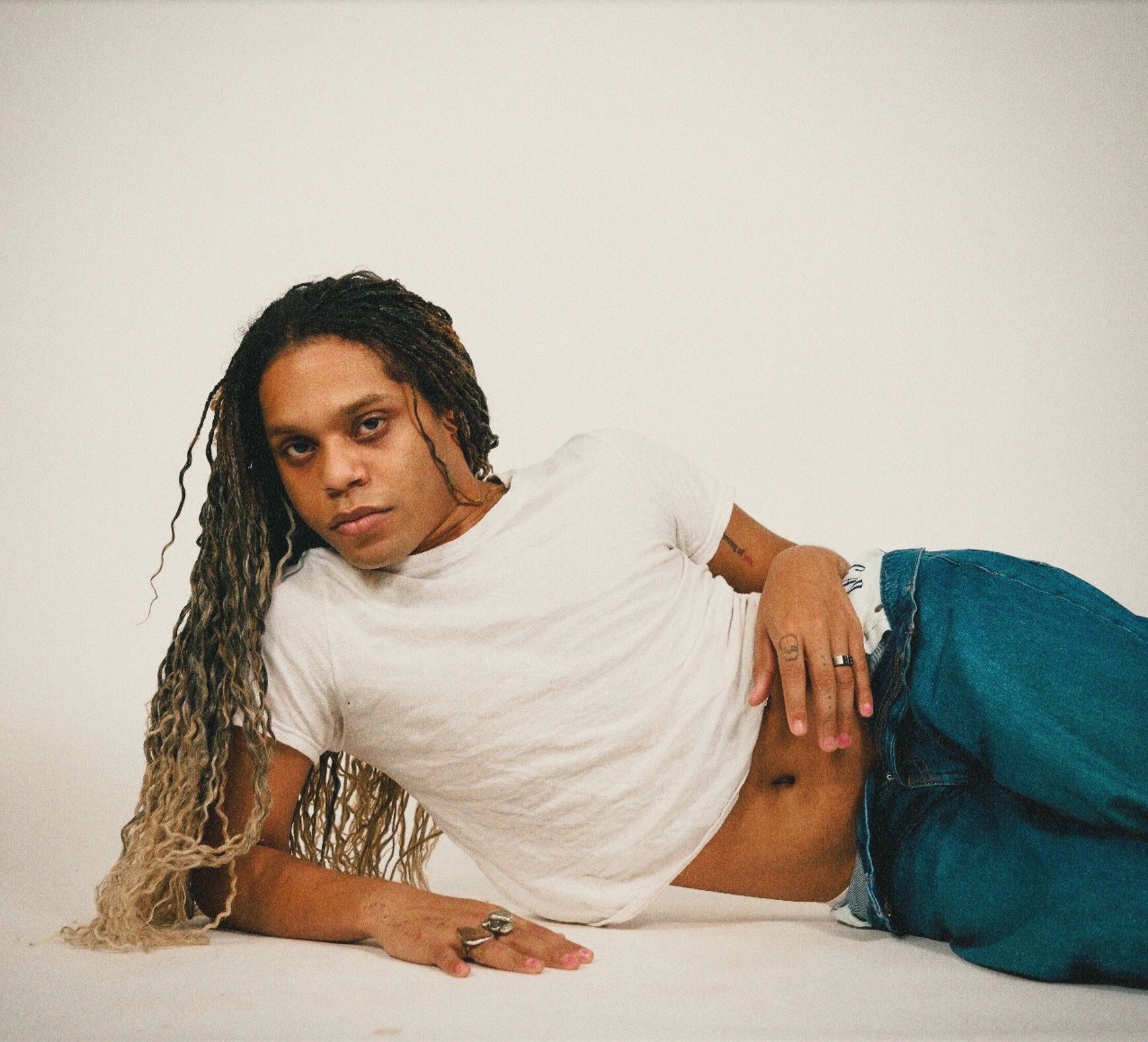
Photo courtesy of Lady Gracie May
As a theater kid with glam rock beginnings as frontperson for The Past Lives, Quentin makes glittery, confessional pop-rock perfect for crying in the pit. Ahead of their MeadowFest performance on August 29, the Austin-based artist sat down with Luna Harper to discuss their debut solo album, TOMGIRL.
Luna Harper: Can you tell me more about your origins in Corpus Christi, and what inspired you to pursue music?
Quentin: I grew up in Corpus. I’m adopted. My dad and my mom—my adoptive parents; I just call them my parents—actually met at a recording studio at Hacienda Records, which my uncle owned. I think he’s like my great-uncle, but I called him my uncle. But anyway, I kind of always grew up with music. Growing up in South Texas, [it was] predominantly Tejano music. That was a lot of my earliest influence, and a lot of Christian music.
My grandpa was a huge music nerd, so I grew up listening to Earth, Wind and Fire, and The Supremes, and Donna Summer, and Carole King, and I actually thought that that's just what music was. I didn't know it was old. I thought that Donna Summer made “Last Dance” just a couple of weeks ago. So I kind of grew up with that. And then I did regional and local theater for 10 years, so that was a lot of [my] experience.
When I turned 18, I met my producer that I actually made TOMGIRL with, and started hanging out at Produce [Bar Co.], which is like a label, or whatever you want to call it; a collective in Corpus. Yeah, I guess that's a speed date version of my life in South Texas.
You’re based in Austin, now, correct?
Yeah.
What prompted that move, and have you been able to maintain your connections to the Corpus Christi scene?
First of all, everybody that's still currently on my team that I work with—at least creatively, artistically—are still the same people from Corpus. I really haven't changed, and I don't think I will. I mean, check in with me in five years. But I feel like they're just the most incredible people I know. What was the other part of the question?
What prompted the move to Austin?
I think I was like, “I need to go somewhere. I need to go figure out something somewhere else.” And I came to Austin and started performing at Kick Butt [Coffee]. That was the first place I ever really performed, and I would just do covers. It was a long Austin road. It was a long Austin journey to get to where I'm going now. But yeah, it just was time. I was like, “I'm out of here. I gotta go.”
It’s great how even though you’ve moved places, your music still feels deeply rooted in Texas. “Lucy in Disguise,” for example, is inspired by the now-closed South Congress shop of the same name. For a lot of queer people like us, Texas can bring a lot of mixed experiences. What was it like for you growing up in a red state, and how has that influenced your approach to identity in your music?
I feel like I've always been very protected—the only way I can word is by the universe. I wasn't really bullied growing up. I think I always had the fact that I was talented as a protective mechanism. I think people didn't fuck with me because they needed me... So to me, I feel like I've never necessarily had a difficult time being me here.
I think also I'm lucky because eight times out of 10, sometimes people just think I'm a biological girl anyway when they meet me. I’m only living my experience and my reality of Texas, and I know everybody's story is different, but for me, I've never really had too much of an issue with it. I think I have always surrounded myself with people that love me, and support me, and make me feel great.
Also, I'm a theater kid, so I grew up with criticism. I grew up getting [criticized] in front of a cast of 150 people. So negative conversation, negative dialogue, anything that's negative about me doesn't really inherently affect me. I don't know how to explain it, it doesn’t bother me.
It’s like how Marsha P. Johnson would say: “Pay it no mind.”
My queen! We just got the vinyl [for TOMGIRL], and Marsha P. Johnson is on the back of my vinyl.
That’s amazing!
It's so weird. I feel like I do a lot of what I do for her. It's like this weird thing. I don't know how to explain it, but I feel very protective of her. One of my biggest goals in life is to make a biopic about her. I want to play her.
I could totally see that for you.
It’s my number one goal right now in life: it’s to play Marsha P. Johnson.
That would be incredible.
Yeah, I love her.
On the topic of queer and Black icons, you already mentioned a lot of the music you grew up listening to. What are some Black and/or queer icons that have influenced your artistry?
I would definitely say number one is Tina Turner. We could really stop there, but Tina Turner is my Lord and Savior, honestly. I will say—he’s not queer—but Lenny Kravitz. I read his book. I read biographies; that's like my thing. And I'm nothing like him, we have no parallel of a story, but there's something energetically about him that I feel really connected to, just in his energy and his style. I'm somewhere between him and Lisa Bonet, which I guess would be Zoë Kravitz, but I'm not Zoë Kravitz.
My Lord and Savior, of course, is also Beyoncé. I’m trying to think—Brittany Howard, who is just absolutely incredible. Arlo Parks—just absolutely obsessed with them, and their new album they just came out with was just beyond for me. That's the main ones that are Black and queer, or queer-adjacent, that I could think of right now. I'm sure I'm skipping like 80, but those are the ones that immediately came to my brain.
I can see how those influences seep into TOMGIRL, which is very glam rock and larger-than-life, but still feels authentic. You’ve played up different characters in previous projects, but you’re stripping that back and being truer to yourself with this project. What was that songwriting process like for you?
It was random and sudden, which is so rare for me. We were writing a whole other album for a while, and it's a very different energy. And you may or may not hear it soon, but we were on a whole different thing. And then—I don't know, I just started getting sadder. I think that's what happened. And I was just kind of exhausted. And I was just like, “I just kind of want to just tell it the way that I want to tell it,” and it just started.
It wasn't this big writing process. I was just getting these downloads—that's what I call them. Like “revolve” came to me in a full song. “RESENTMENT” came to me in a full song. I would say almost every single one of these came out fully baked, like this download that I put on a voice memo and then ran to [producer] Kinderr’s. Almost all of these songs I just played on the piano and then brought it to Kinderr, and then we vamped it up.
So I think there is something to be said of the fact that these were all these ballady songs, from “i miss new york” to—well not “LUCY [IN DISGUISE].” “LUCY” came out like “LUCY” came out. But “HELLO DENIAL” was this piano ballad. “PEANUT BUTTER CIGARETTES” was actually the most piano ballad song of them all, and it's always so funny that it is what it is now because it was just like, [starts singing softly]. It was like this beautiful little sad song that was on a grand [piano] and my friend Sammy on acoustic [guitar], and then we high-octaned [sic] it.
The process was scattered, and it was just kind of all over the place, and we were making a whole other thing sometimes randomly in between it. I think my most sad days produced the TOMGIRL album.
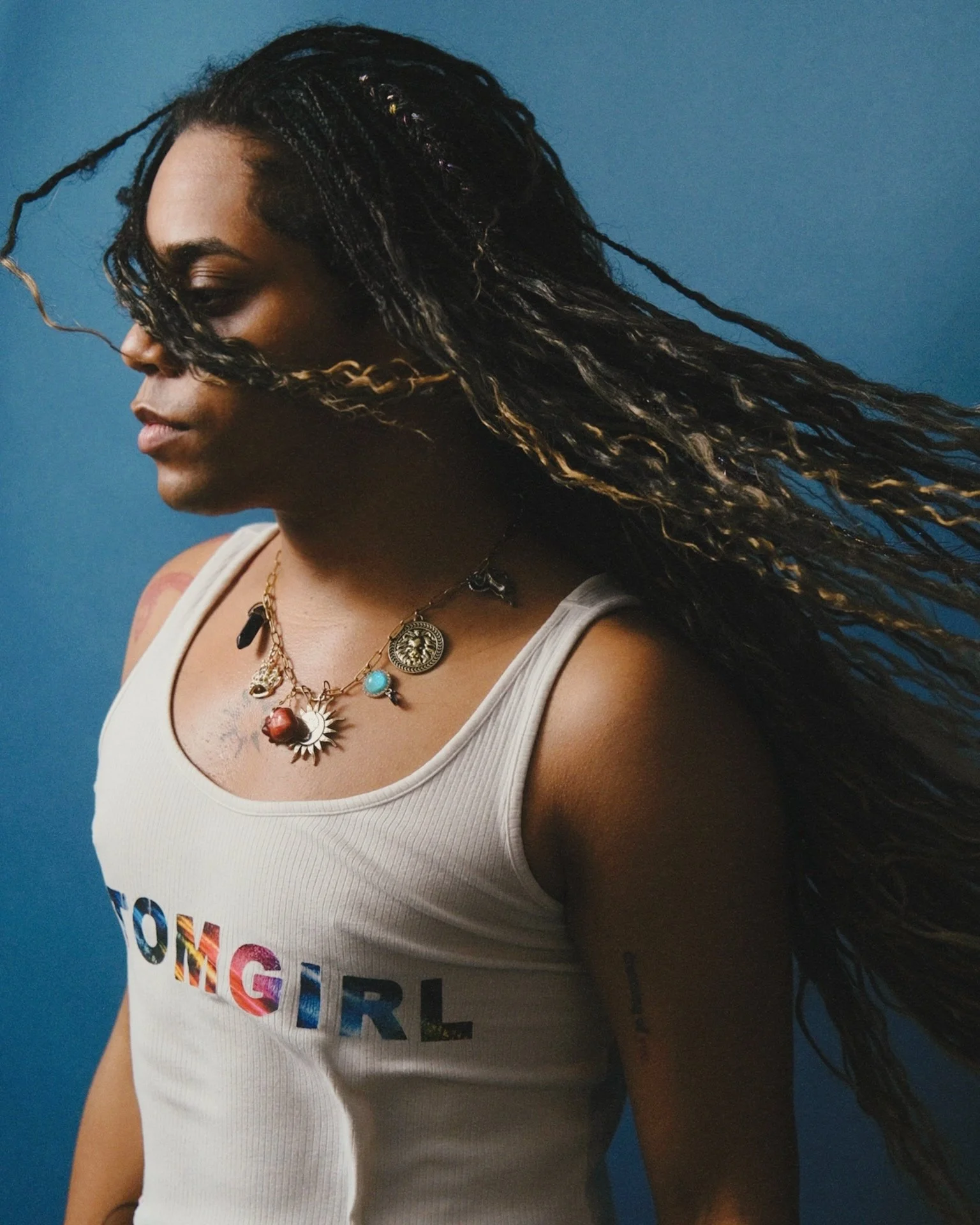
Photo courtesy of Justin Heron
Listening to your record, I’m surprised to hear about your process because I feel so much power and energy coming through TOMGIRL. Of course, there’s still some piano ballads there, but songs like “PEANUT BUTTER CIGARETTES” and “LUCY IN DISGUISE” feel very pop-rock, almost power pop.
Power pop is really cool, yeah. But…they’re sad. If you actually read the lyrics of “PEANUT BUTTER,” verse two is, “I’ve got a feeling that you’re thinking of her / and I know, I know, I know / And I’ve gotten skinny because I’m not eating.” I’m literally talking about infidelity and an eating disorder in just the second verse alone.
Everything of this project is kind of what I call the “hey ya,” where you're taking the song that actually has some really heavy content, and you’re just pumping this beat behind it. I think that that, to me, is so tomgirl, and to me that’s also the way that I got through it, like the way that I overcame it was [by] tomgirling it: taking these contradictive [sic] things and putting them together and making something beautiful. That is, to me, the definition of a tomgirl, it’s just a contradiction, like an oxymoron.
I was actually going to ask what tomgirl means to you. I love all these juxtapositions throughout the record, down to the album cover. It feels like you’re stripping away all the makeup and wigs to leave the person beneath the persona. What was it like creating this album cover and the whole concept of the tomgirl?
Well, me and my friend Justin Heron, who shot it…we're little nerds. And to me, everything is about an album cover. I saw this cover when we were writing [the album]. It's just always kind of been there in my head, even before it was going to be officially called TOMGIRL, and so it was kind of like this journey.
I wanted to be quite meta with it, and so we did a whole shoot that day with me dressed up as Tom, which was hypermasculine. You know, I had shoulder pads…and then did a full beat, full wig, full glam girl, and shot that. And then quite literally, I took all of that makeup off, like authentically, and took the wig off, and then you reveal, what is the cover, which is the tomgirl. I was like, “It has to be meta in this weird way. I think people would know if it was staged.”
I think when you're looking at it, there's this sense of authenticity that you may not even notice you're picking up on, and I was just like, “I think people will smell if I just slapped a wig cap on.” I was tired; it was the last thing we shot for the day. I needed to look like I had just been spending hours being other people, which is also so much a part of the story. And there's so many Easter eggs. There's so many things in it that I can't wait for, down the line, people to be able to piece together.
I love the theatrics beneath your artistry. Watching the music video for “PEANUT BUTTER CIGARETTES,” it felt like campy vintage horror, which can feel cathartic for many of us as queer people. As you mentioned, it’s a song of juxtapositions: it’s deeply sad, but also powerful sonically, and then you have this horror theme in the visuals. How did you piece all of that together?
Quentin: Fun fact: We shot a whole other music video, and I hated it. That was such a hard call to my manager of just being like, "This is not it, guys.” I think what gets lost in the story a bit that…I would like to be noted is that I direct and predominantly edit all of my videos. You know, it's just me and my friend Ducky. That's it. There is no team. It's just me and him and a tripod and a dream. And so I always thought about the peanut butter monster—that's what we call him—and I had always thought about him. And I feel like after shooting “LUCY,” it gave me permission to…bring characters into a world of me being stripped of characters. It felt a little bit hypocritical. But I don't know why, it just kind of gave me permission. I was like, “As long as I'm in it.” These other versions of me, they still exist. This album is just about bringing this one more forward.
And so I just kept thinking about the peanut butter monster, and I kept thinking, “Well, we called him the peanut butter monster. So why not make it horror?” And I hate horror films. I don't like them. I don't want to see them. I have no interest in them. And I kind of always joke about one day I'm gonna make a horror film, because of how much I hate horror. Like Sarah Paulson, she always talks about how she actually hates horror films—
Really?
Quentin: Yeah, she hates horror films, but she's in some of the most iconic horror [media] of our generation. So I just always think about that, and so I was like, “It would just be so fun to play a character that isn't even really a human.” I just thought that that would be so fun.
Also, I think your past and your traumas that you've maybe had with other relationships—whether it be infidelity, whatever it is—can haunt you. And I was like, “Maybe we can make that literal and give a literal haunting.” Being haunted by this memory, this almost amalgamation monster of the things that you miss of this person. It’s like this weird shadow monster of your fears or of this person.
So I thought it would be fun to have the main character of that video not be me, and to bring someone completely left field into the world, which is my friend Katie. Shout out Katie, that girl worked that day. Oh my God, we put her through it. It was just so much fun, and it just felt right. I just wanted these stills. I was like, “Let's just do these stills, like these moments of me.” Almost like pictures, paintings, even, of just me and these random moments.
We were just trying to make it too complicated. It’s like, let's stop complicating this. Let's just make it easy, and really let the short film be what drives it. And have the music video actually just be this stuff that’s kind of in the middle that still matters and has a lot of symbolism behind it.
If I might ask: what was the original video for “PEANUT BUTTER CIGARETTES” like?
Quentin: It was choreography. And it was just different shots, but there was no plot. There was no peanut butter monster plot. I had a body cam on, and I was walking around South Congress full head-to-toe in peanut butter, smoking a cigarette. We were on a whole different vibe.
It was crazy because we shot that months ago, and then we shot “i miss new york,” and then we shot “LUCY,” and then we got better. So we were like, "Wait, let's go back in, and let's go reshoot ‘PEANUT BUTTER’ now that we know how this world works.
You mention South Congress a lot. You’ve shot there before, and “LUCY IN DISGUISE” was inspired by the sadly closed shop on South Congress. What does that particular area of Austin mean to you?
Quentin: That's a really good question, and I'm really glad that you asked that, because it was the first place I ever went to when I came to Austin. I stopped my car, went into this little Sunglass Hut, met my friend Stella—who is still one of my close friends to this day—and asked for a phone charger. Because I had no plan, and I just randomly decided I was going to move to Austin.
She gave me a phone charger, and I didn't even barely have enough gas to get to see her park. But it was the first place I ever went… For two years, up until February of this year, I lived on South Congress. So when we were shooting, a lot of this was right outside my door. So it was convenience, but it was also like just the history of me with this street. And yeah, I love South Congress. I hope that they take care of it. I think when they take Home Slice [Pizza], I think that that's when we should start rioting.
Powerful words right there.
Quentin: Please quote that. If you take away Home Slice, we will be rioting.
Anything you’d like to plug?
Quentin: We have vinyl, and it’s gonna be available at Waterloo [Records]. I think that’s the biggest thing. Also, [I’m playing] MeadowFest…on August 29.
This interview has been minimally edited for clarity.
You can find Quentin on streaming platforms such as Spotify and on social media such as Instagram and TikTok. Catch their performance at MeadowFest 2026 on August 29.