Ahead of a screening event on November 1, Meghan Ross discusses her Austin PBS docuseries, How We Grieve.
Written by Luna Harper
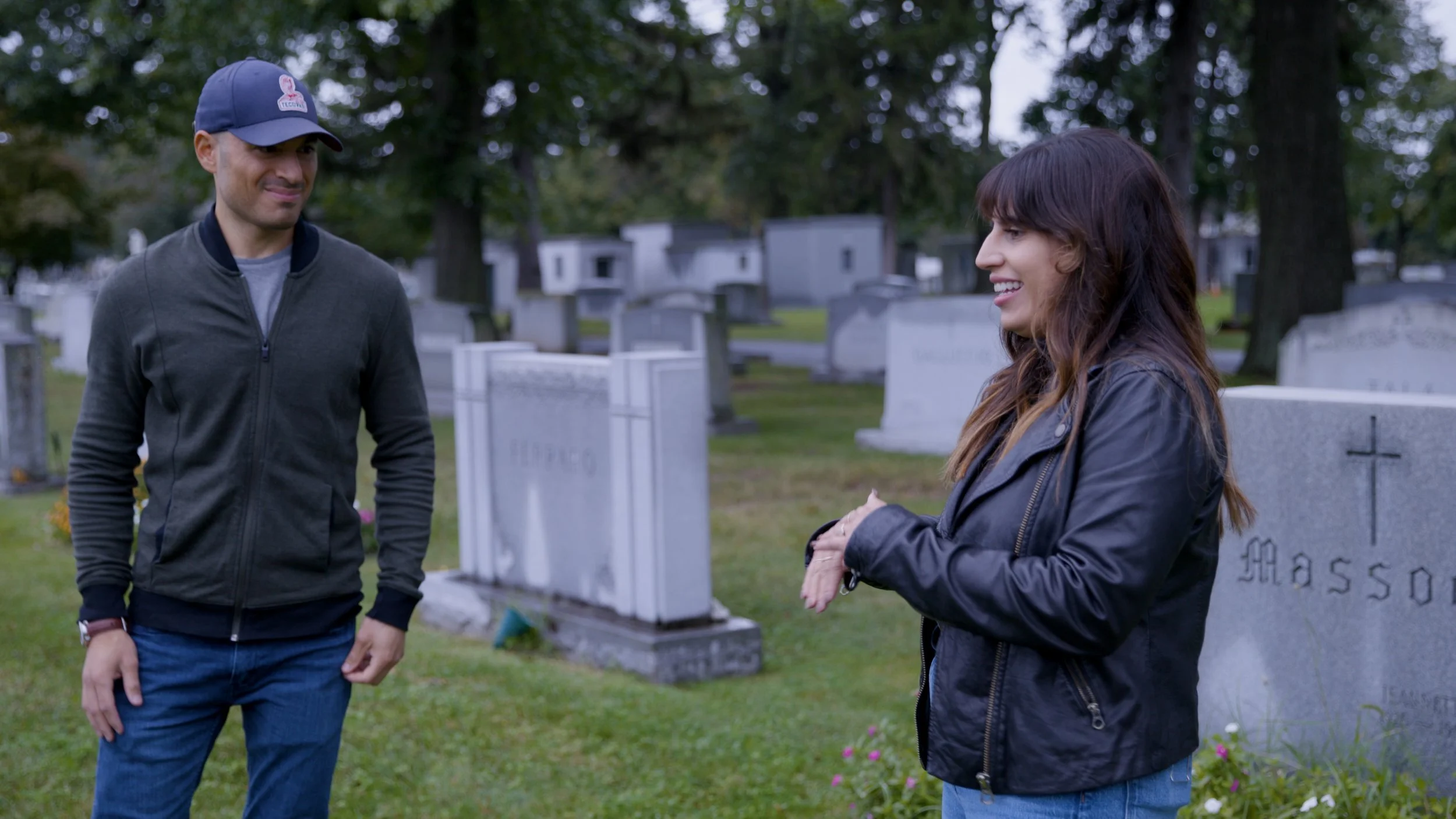
Photo courtesy of Austin PBS / Meghan and Justin Ross
After losing their aunts Dawn and MaryKay in 2017 and 2020, sibling pair Meghan and Justin Ross were left at a loss on how to process their grief. Ultimately, the filmmaking duo confronted death the best way they knew how: through comedy. Over three years, the Ross siblings set out to challenge their notions about end of life by talking to fellow grievers about this taboo topic. The result is How We Grieve, a three-part traumedy docuseries that thoughtfully explores how people can process death through art and humor. Ahead of a screening of the series finale on November 1, Luna Harper spoke with Meghan Ross to learn more about the project.
Luna Harper: In episode one of How We Grieve, you mentioned that you made a lot of different projects when you were navigating the loss of your aunts, before switching gears to this project, How We Grieve. What made this docuseries feel like the right way to broach this topic of death and grief?
Meghan Ross: The previous projects felt more like I'm just sort of trying to figure out where to place my emotions without really kind of diving into or talking about the emotions. It felt like they were distractions. After my aunt Dawn's wake and funeral, I had a comedy show already scheduled a week later, and I was like, “Well, I'm dedicating it to her.” On the plane ride home, I was writing a monologue that was really like a memorial sort of speech. And then the first short film I made also was like, “Oh, I need to put my feelings somewhere.” So I wrote and directed my first short film that was about a woman going through the process of grieving her mother. The previous iterations of us trying to find creative outlets felt more like… going through the motions without really talking about grief. And then when this idea came to me… we had just made a short film that we had dedicated to both aunts, and it was about female friendship because my mom—they were sisters and friends—and so that project went through a series of rejection. I thought that project was like me trying to make them proud. So I think because I was in this moment of “this isn't enough, I'm not doing enough to manage my feelings.” How We Grieve [questioned] “Wait a minute, why is this an underlying current in all of our projects, even though our family doesn't talk about it?” [Grief] is not something we actually explore, even if we keep dedicating these films to them.
That leads me to my next question: you grew up with a family and culture of avoiding the topic of death and grief. What was it like actually having to confront this with this project?
Ross: Yeah, it was definitely uncomfortable. I feel like the project itself allowed us to have that excuse of “Well, we're making something,” and our parents are supportive of our film endeavors. But I think if we didn't have the structure of “Oh, we're filming this for our docuseries,” we probably would not have had that conversation. It was the first time we sat down with both of my parents and just straight out asked them how they felt about the losses they've had—some of the losses were before we were born—and how they handle grief. And it was really eye-opening. I knew my mom was a little bit more open with her grief, but my dad was known to just not ever really show that. He lost both his parents at a young age, he lost siblings, he dealt with a lot more grief early on, and you wouldn't know it because his survival tactic was, “I need to move on. I can't dwell in the grief.” So it was really tough, but I feel like it was helpful for all of us to understand, and [for] my brother and I [to] be more empathetic to their method of grieving and maybe not being as open about talking about it as us as millennials were.
In episode two, you show yourselves talking with your parents and starting to address the topic. Now that the series is out, has that changed the dynamics in your family, or is that an ongoing process?
Ross: It’s funny, my mom asked me to send her the episode, so I know she watched and she really enjoyed it, especially the second episode, because we spent a little bit more time in that scene with them. And she mentioned that it really touched her. I think it was a starting point. It’s not gonna change things overnight. I'm thinking about anytime there's one of our aunt's birthdays or the anniversary of their death, will that make us more open to talking about them? I think we're still trying to figure out what that looks like. It's funny, because I want to be able to openly talk about these people who were in our lives and meant so much, but I also have the instinct, which is why my family doesn't talk about it, of not wanting to upset anyone. You think you'll get in trouble if you say something that will make someone cry and it's like you're trying to protect everyone’s peace. And sometimes that actually makes it worse, because we're all repressing these feelings until they bubble up in a different moment in time that makes it unbearable.
In the show, you and Justin discussed your Syrian heritage. For a lot of us as children of immigrants, we have this pressure to repress our emotions. How do you hope How We Grieve can change the conversation about death for immigrant families?
Ross: I hope it especially helps generations that are in the crosshairs of that. My dad's first gen, but we've been here [in the United States] for a long time. Our family is very American. But we still have this inherited way of dealing with our feelings. This is the immigrant mentality of you push forward, and you work hard, and you distract yourself with work, and you build a better life, and you don't think of the past that was harder and worse for those who came before us. But I also hope that we can figure out a way to honor our past while also being open to having these conversations with our kids and the next generation. So it doesn't have to be one or the other: if you're from [the] boomer or silent generation, you're not talking about it, but if you’re millennial or Gen Z, all you do is want to talk about it. I want it to be more fluid and open for both of those conversations, and not be this generational difference. I've witnessed a lot more seeing my parents, seeing great-grandparents’ generation of trauma versus for us [as millennials], we didn't witness as much of those struggles, those immigrant struggles. So, I just hope that it becomes more normalized. Talking to the artist in the third episode, Allie García, she was like, “My heritage is Mexican. This is a non-issue. We talk about it all the time. It's embedded: life and death, one and the same.” And it's such a different way to handle the inevitable and also illnesses, and things that come up. I hope that this helps find the middle ground for families with different cultures, different generational backgrounds [to be] able to hold space for each other and not be like, “I can't rock the boat ever.”
I love this idea of the middle ground with these conversations. I also like how you mentioned changing the narrative for the next generation, because you and Justin had the experience of becoming parents throughout the production of How We Grieve. How has the series influenced your approach to parenting around these topics?
Ross: I feel like a student all over again. I'm not in school anymore, but I am now a student of life and I'm learning from people who are in the death care space: this is how you have conversations about loss, and this is how you broach the topic, and maybe the first time your children may experience [loss]. I have a senior dog, so I've been pre-grieving him for a while and my son is very close with our dog, and so that's going to be the first conversation. I mentioned this in the third episode, too. While I was working on the series, I came across a book from Sesame Street, [The Day of the Dead on Sesame Street!], and Rosita, who’s the Mexican character, describes [death] very plain-spokenly—she doesn’t dumb it down or anything. It was very approachable language for a child about Día de los Muertos and how they honor their older relatives, their grandparents or great-grandparents who have passed away. And even though my kid is only two, I'm telling him these things in a way that I'm like, “I don't want him to be scared. I don't want him to think [that] as soon as someone dies, don’t ever bring up their name.” I think that there's a lot we can borrow from other cultures that have always been really open about it. And not instill this fear of being able to come to your parents and talk about these things, or not wanting to see someone cry. The whole [idea of] don't let anyone see you upset, because that'll upset them—that is a big thing in my family, and I don't want that to be something that stifles my kid’s emotional maturity. I think it's very human to cry in front of each other and to show emotions.
How We Grieve was shot over several years in multiple locations, and you explored a lot of different perspectives on death and grief. Can you walk me through the process of planning out and producing the series?
Ross: I would say the first year before we actually filmed, we talked about it a lot. We were having conversations with other friends who are filmmakers [and] who'd worked on our past projects, and trying to figure out, “What will this project look like? What can we capture? What can we afford to make?” We had come out of making a short film. Short narratives can be really expensive, because you need a lot more people, so you have to have a fuller crew. And this was the first documentary project that my brother and I were pursuing. So because it was documentary style, and you're given a little bit more flexibility of the footage not being as polished and feeling a little bit more lived in, we were able to film it with a very small crew. The first shoot was my brother on one camera, my cousin on another camera, and my cousin handling sound at the same time. And we didn't have a lighting person. It was very scrappy, which also allowed us to capture more intimate moments and not be invasive when we're coming into different spaces.
…[In] the first episode, we wanted to explore comedy because that was our starting point into processing grief. And my friend Ben Wasserman was working on this show [Live After Death], and luckily, the timing worked out perfectly that he was just about to end his monthly run of that show at Blair Mazzarella Funeral Home in Brooklyn before going on a tour with Live After Death. So we quickly put together a plan to shoot with Ben.
I believe it was September 2023, and we were still figuring out what [this would] look like, and I knew that we needed to introduce [ourselves] as the hosts and our connection to the story. I remember thinking—and we never explicitly talked about this in our family, it was just something you accept—but just how funny it is that there's an ice cream shop within yards of where our relatives are buried. And so all of our memories of going to a funeral [and] tending to the plots is associated with getting ice cream afterwards. So I thought how naturally humorous that was. So we filmed that all in one day, and it was the first time I was back at my aunt's burial spot since the funeral—at that point [it had been] seven, eight years prior. So it was very raw. I was like, “Oh, we can totally do this, and I'll be fine.” And then I was like, “Whoa, this was the first time I've been back since the funeral.” It went into the fact that our family avoids the topic and avoids confronting the grief and death that we know we're all experiencing.
So we filmed that, and then I can't remember how the connection to Good Grief came about besides that my brother had heard about them through his therapist, who recommended this place in New Jersey: Good Grief, the [bereavement] nonprofit. So we went there, and I had just found out I was pregnant. We were still not knowing that these were going to live as three different episodes. So we filmed with Good Grief, we did one day just observing their night of support, and then we went back the next day and did an adult breakout, which we don't show in the episodes, but that was basically us experiencing how they handle adult support groups in their nonprofit. So that was us, me and my brother, having to face those feelings head on, and I cried a lot in that scene as well.
And then there was just a stretch of time where we really didn't [film]. I went up when I was really pregnant to film with my parents, and it was March 2024. But then there [were] several months where part of me didn't want to keep exploring the topic because I was very pregnant in Texas during a time when reproductive care was limited. So I was fearing worst-case scenarios and thinking, there's a world where if something was wrong, they would prioritize the fetus over my life. So death was top of mind for me personally, and I wanted to step away from the project. So there was a stretch of months where we didn't talk about it or do anything, until right before I gave birth, one of my filmmaker friends connected me with her husband, who offered to edit the pilot in kind. We didn't have any resources. We had done everything very scrappily. So that was also keeping us from moving forward. And then as soon as she connected us with our editor, Sam Butler, we finally had a boost of energy into the project. I had just given birth, so we were still very slowly getting into footage and seeing what a pilot would look like.
A year after that, we were sitting with the pilot. We had submitted to a bunch of film festivals. We're getting lots of rejections, [which had] me questioning, “Maybe people don't want a TV show about grief and death.” And a year after that, we got another burst of momentum again, and the first big yes was Austin PBS coming on as our presenting station. And that—similar to Sam coming on to finally edit a pilot—took our project into the next stage where we were like, “We're gonna deliver three episodes; these are the themes that we see naturally coming out of it.”
And after that August confirmation of a year from now, we started being more intentional and thoughtful about what would be included in each episode. There was a period of time this spring into the summer, where we were in post-production, but also thinking of what could be added to the episodes, so we would quickly veer off into [pre-production] and plan a shoot, go shoot, come back into the edit, and be shaping the episode while still in production. It felt like Play-Doh. I'd never done a project where it was live, even when we were in the edit. It wasn't like, “This is the footage we've got.” It was like, “Actually, we need to talk to a family from Good Grief.” So we reached back out, and we got time to talk to a family and hear their experience. It was a very chaotic method of prepping an indie TV series, because I have a full-time day job. [Justin] has a full-time day job, and we have kids and other things going on in our lives, but this means a lot to us, [so] we're gonna get this done. We're really happy with what came of it, even though it was a very kind chaotic approach, but I feel like documentary work requires that…. It's never done.
I still think we have footage with death doulas that we couldn't fit in this season, so we're like, season two. We know we want to keep these conversations going. I relied on my friends in my writers’ group to help me shape it, because we were such a small team, and we couldn't afford to do a focus group screening or anything like that. So [we were] very much depending on our immediate friends and family to help gut check and make sure that we were approaching this topic with care, and also entertainment and some humor.
I think you did a great job of balancing that! I’m surprised to hear that the process was chaotic, because the end result is very well shot, and it’s a thoughtful series. I think y’all did a great job with it.
Ross: Thank you!
You mentioned a potential second season. Do you have any ideas for what you might explore?
Ross: Since we are very much an independent TV series, our project is always going to be dependent on funding. We have ideas ready to go, and it's just a matter of connecting with investors [and] potential corporate underwriters that can help us cover the expenses, because we can't self-fund this given everything else we're balancing, and having families and stuff like that. A dream would be to jump into filming next year if we were to get potential financial supporters. We've thought about taking season two and making it more—these first three [episodes] were more personally connected to us—but wanting to explore these newer topics. Maybe not new to the people who have been in the death care space, but would be new to the public, like aquamation and natural burials and death cafes and death doulas, and all these topics that we've seen come up in our filming, but we haven't had the time and the resources to really dive deep on them.
I also really would love to explore one episode on music and grief, because there's a really cool organization here in Austin called Swan Songs that provides free concerts for people on their deathbeds. They'll match families, maybe if they have a family member in hospice care or whatever the situation is, and they will curate an intimate private concert based on their favorite songs [and] their favorite genre. And it's such a beautiful way to incorporate music and a little bit of joy in what would otherwise be a very traumatic last stage of your life.
If season 2 comes to fruition, I’d be looking forward to hearing more about these resources!
Ross: [Crosses fingers] here’s hoping.
Here’s hoping! Pivoting a bit, there was a quote that your brother said in the final episode, when you’re sitting at Damasco Cafe in New Jersey and reflecting on your experience with the show. He says, “Once you accept death, and grief, and end of life, you can really start living.” How has this journey influenced the way you approach not just death, but your own life? What do you hope audiences get out of the show?
Ross: Another thing that my brother and I have in common, besides both being filmmakers who lost these two aunts, is that we both have an intense fear of death. We don't talk about it a lot in the series, but I have OCD, and I mentioned briefly in that scene that one of my triggers is that fear of death. And my brother had a near-death experience, so we hold a lot of anxiety around death. And making this series, and being exposed to the topic, and talking to people who are in these spaces, whether it's in grief support or death care, they're so lively, and supportive, and kind and they basically all were like, “Once you understand [death] is something you can't avoid, and you have that level of acceptance, it makes you want to live life to the fullest because of how fragile and short life is. I think a lot of people… coming out of a tragic loss—especially someone who maybe died young versus a great-grandparent—it's a reminder [that] we really should be taking advantage of each day we get, because nothing's guaranteed. It really makes you take stock of what you want to be spending your time on, and who you want to be spending your time with. That was a big lesson coming out of it that we learned from people who are talking about these topics on the daily in their lives and their jobs. I'm always like, how do you not live in this constant state of depression? And it's because they're seeing the flip side of it. This is a reason to live fully, knowing that we're all going to experience this, [this] is a universal thing that we all experience.
That’s something that the producer of Dying to Know Film Festival was getting at in her appearance in How We Grieve.
Ross: Caren Martineau, yeah, she's fascinating. And hearing her say that was such a confirmation that someone who is surrounded by this topic has reached that point in her life to be like, “Now I can use this as a way to live fully and to not dwell on the negative associated with. what we traditionally think of with end of life.” End of life doesn't have to be this bad thing. It can be a reason for us to celebrate the time with each other and the time we do have.
It also makes me think back to the footage you included from Sesame Street, where some characters were telling Big Bird that they could celebrate their late friend’s life. Like, they could be sad, but it can also be cause for celebration. I appreciate how Sesame Street approached the topic for children.
Ross: Yeah, people we've talked to who are in this space and working in grief education, a thing that came up... while we were in [production] is two things can be true. Something can be sad, and it could be joyous. You can be deeply upset about something, but also laughing at the same time. And I feel that those two emotions, holding space for both of them, was a perfect way to describe those early stages of grief about my aunts where these are people who meant so much to us, and would influence our humor, and so many fun memories with them, and I can also be really sad about not having that anymore, and it's okay to hold space for both of those things. Post-traumatic growth is a term I kept hearing come up from different people we talked to. And it is taking this challenging thing, and then seeing what can come from the aftermath of experiencing it.
I’m going to have to look up that term now! I’m interested in learning more. You recently had a screening and open mic to promote the series at Cactus Café at UT Austin. What was that experience like?
Ross: That was a really cool opportunity. We partnered with UT School of Social Work's Moritz Center [for Societal Impact], who I didn't know existed, and I am so glad that they exist, and that they're looking for ways to incorporate art, and film, and music in their programming for their students. So I didn't really know what to expect [from a] grief-themed open mic. It was the first event associated with our [docuseries] that I wasn't deeply involved in planning. [The Moritz Center was] handling the comms between the artists that were signing up, and I was really there to show up, and share the film, and hold the conversation. The conversation with [program director] Andy [Langer] was wonderful, but sitting in the audience and witnessing everyone else's forms of processing their grief through their own art, whether it was a song or poetry—I felt so honored to be able to witness their grief. My brother and I made this project, and it was partially selfish for us to deal with our fear of grief and death ourselves, and partially also hoping that it could be something useful to other people. I'm a comedian, so the shame has been taken away from me a long time ago. I'm so used to being vulnerable and putting it all out there. But then being on the receiving end of that for these people from all walks of life who—some shared a little bit about their people that they were grieving, and some just got into the poem or the song—and it was just so moving. And I'm a very emotional person, but I started crying towards the end. But it was really beautiful, and I could not imagine that I'd get the opportunity to do that with this project, to be able to see other people's ways of grieving through art.
That sounds so healing. You also have an upcoming finale screening on November 1 at BRB Coffee in Austin. What are you hoping this experience will be like?
Ross: I'm really excited about that one, too, because… we're leaning into the Arab side of this project. We partnered with Beitna, which is an organization in town that promotes arts and culture from SWANA people. And funnily enough, while I was working on getting this project made back in the spring, I got coffee at BRB Coffee, and I started talking to one of the owners, Youssef. His family's from Aleppo, Syria, where my family immigrated from, and there was just so much we had in common with our upbringing. I had told him we're exploring this topic [of grief] because our Arab family does not talk about our feelings. So they've been supportive of our project since… so it felt very fitting to do the finale screening where we do feature another Syrian-owned cafe in New Jersey, where my brother and I are sitting and eating Syrian breakfast. There's not a lot of spaces growing up that I could find that had things that reminded me of my upbringing, and so to be in a small business like BRB Coffee, and then be surrounded by other SWANA artists—we're gonna have live music. We have my friend doing a tattoo raffle who's Lebanese, and we also bonded over our upbringing. So I'm really excited, because my upbringing was a part of my life that, like my feelings [about] grief and death, I suppressed when I was in high school and a little bit in college, because you're trying to blend in, you're trying to whitewash yourself in order to fit in with other groups of kids. It wasn’t cool to be different back then, and now people are embracing their family upbringing, and it doesn't have to be this thing of shame. So to have this very public-facing event where we're all very proud of our upbringing despite all the flaws that it brings with immigrant parents and grandparents that don't talk about their feelings, it's this really cool celebration, so I'm excited for that.
That feels like a very full circle moment for this project and everything that you and Justin have been exploring.
Ross: It’s taken me a long time to find other people who are wanting to [do this]. I wanted to do an all-SWANA lineup of comedians 10 years ago when I first moved here [to Austin], but there was barely anyone when I posted the Facebook status… And to see that there is a community, that there are people who are interested in trying knafé, and all these things. It does feel very full circle. It took me a while to find this type of community, and now we're able to partner together on this event.
This interview has been minimally edited for clarity and length.
You can learn more about How We Grieve on the series’ website and stream it for free on PBS Austin.