Interview: Gåte
Lead singer Gunnhild Sundli and guitarist Magnus Børmark of Norwegian band Gåte discuss their latest album, Sigil.
Written by Luna Harper
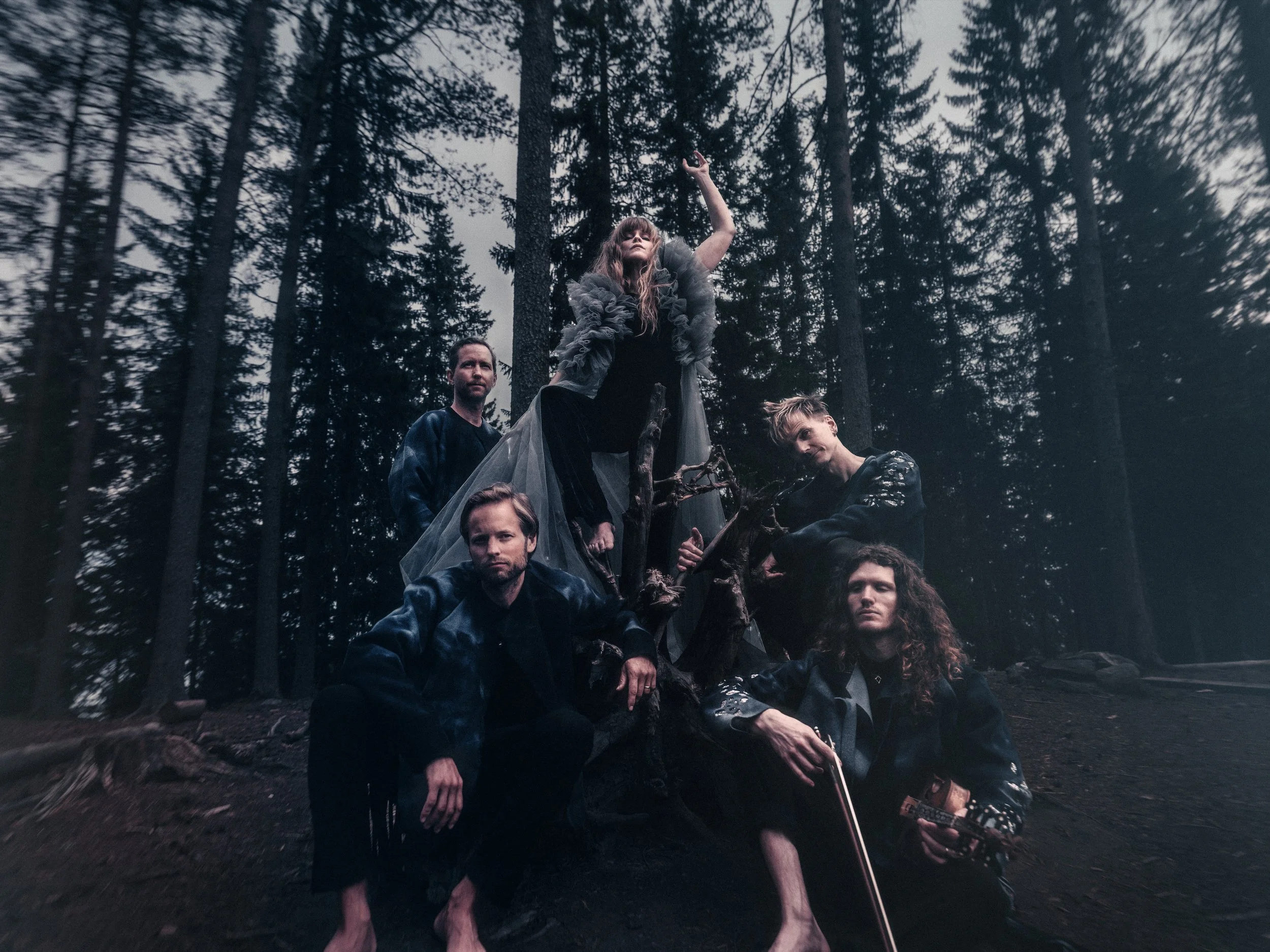
Photo courtesy of Ole Ekker
From their beginnings as Norwegian child stars to their crowning as Eurovision grand finalists, Gåte have celebrated massive milestones in their seasoned career. The folk-rock band’s latest achievement comes in the form of Sigil, their sixth record and international debut with the record label Season of Mist. On the album’s release day, Luna Harper sat down with vocalist Gunnhild Sundli and guitarist Magnus Børmark to reflect on the band’s evolution.
Luna Harper: Congratulations on releasing Sigil! What are y'all most excited about with this new project?
Magnus Børmark: [chuckles] Thank you! Thank you very much. For us, what we are most excited about is [that] actually, this is an album that marks a significant new chapter for us. It’s our first album on Season of Mist, so this is the first time we have a proper international launch of our music. And it really feels like coming home as well. And of course, Maria Franz from Heilung was involved in introducing us to Season of Mist. We've done things a little differently this time. We took a huge leap, so it's actually unlike any other record we have made, and it was made in a different way as well. What do you think, Gunnhild?
Gunnhild Sundli: It feels great! Although also, it's an ordinary Friday [involving] kids and everything, so I feel that I haven't had the chance to celebrate—like really celebrate—yet. But we will take time to do that, won’t we, Magnus?
Børmark: Yeah, me and Gunnhild met this morning and did an early interview on national Norwegian radio and played a song there, so that was a good—
Sundli: That was a good start.
Børmark: A good start to meet up and just congratulate each other and just launch it on national radio here in Norway.
Sundli: But first of all, we're very much looking forward to [playing] concerts with this new music and our new songs, because an album is mostly a ticket for us to get out onstage. That is where we feel really at home.
You mentioned this is your first international release. What inspired you to sign with Season of Mist, and how are you hoping your fanbase will grow from this partnership?
Børmark: I mean, we were child stars in the beginning of the 2000s, from 2000 to 2005, so we were very young. Gunnhild was like 13, 14 years old, I was 15, 16. And then we had a 12-year hiatus and started again in 2017. And we had a huge success in Norway in the first round, and no one really predicted that we would be so successful in Norway. We were as superstar as you can get in Norway, like winning the Grammys and being on television all the time. And it's like, “Wow! Folk music mixed with rock and electronics.”
But since then, up until this day and age, the northern folklore and the myths of the north [have] become so popular and [have] engaged such a large audience all over the world. So for us, this means actually doing what we have always done. It's the same project, like tapping into those timeless myths and legends and using the old folk traditional instruments—and of course Gunnhild, her really idiosyncratic way of singing—and bringing it into the world now. And in the meantime, the world has really evolved an appetite for it, so that's what's really different now, I feel, at least.
What prompted your hiatus, and how did your music evolve during your comeback?
Sundli: Ooh, okay! In one way, [it’s] always changing, but as we have talked a lot about, we look at Gåte and we say that it has its own DNA, in a way. So I think even if we try to shake it up and do something very, very different, it will still sound like Gåte. We can't run away from it, because we're getting together and you have my voice in the center there.
And that's also something: we're a creatively open space this time working with this album, because we trusted the DNA much more than what we had done before, I think. And [we] allowed [ourselves] to not think too much and just create. And therefore, also, you can listen to an album that has a wide range in both genres and expressions, and every song is very strong [by] itself. But still, it's connected. I'm very proud of what we have made and that everything ended up connected, although it’s also so different.
Børmark: I think as you were saying, Gunnhild, it's a very varied album, as we touch on the riff-based heavy songs, and we have the more ritual, pagan, neo-folk songs that [are] touching upon the Heilung territory, like with “Sannsiger.” Then you have the feeble, really vulnerable songs like “Jostedalsrypa” at the end. And for us, as you were saying, Gunnhild, if the story demands craziness and a lot of energy, the song will be a metal song. But if the song demands something else, we will use the genre as a means of expression. Whereas a lot of other bands, at least in this musical segment, they would be more niche, like every song would be more refined in a certain style, but we are and always have been kind of varied, and maybe more varied than anytime before on this album.
Sundli: But still—we dared to be more varied—but still, everything is Gåte. It’s there strongly, you can hear it. I think that's a good experience that we learned about ourselves.
It’s cool that you’ve expanded your horizons while still staying true to yourselves as Gåte. And with that expansion, of course, you collaborated with Maria Franz of Heilung for “Sannsiger.” What was it like being in the studio with her?
Børmark: We had this song, an old idea. I've known her from a distance and from many years ago, from my previous band playing in Denmark many, many years ago. And so we've always been seeing each other sometimes when we've been playing gigs and stuff. But she asked me to play on her Songleikr record—her side project, Songleikr—and she asked if I wanted to join in on that, which I did. And when we were in the studio and recording, we also started talking about, “Okay, but hey, you want to sing on our record?” Also because she introduced us to Season of Mist, and she's a very generous person, and she also has this really sincere connection. She has some deep roots she's working with in her singing and what she does with Heilung.
And then we had this song that was just this loop. It was a song without heavy guitars, without the electric bass, anything. And just a Nyckelharpa and this weird lute thing and was like, maybe that's a song that she could bring something to. And we just sent her the song and she just did her thing. It was also kind of effortless. It just was just made to be, really. And her doing that, collaborating with us, is also about her putting a stamp of approval for her audience on our music. So she's sort of introducing her fans and saying, “Hey, check out Gåte,” which is a gesture that we really, really appreciate. And it's a friendship we also have dearly.
Gunnhild, what was it like for you to share that vocal space with Maria?
Sundli: Well, as Magnus said, I stand by what he's saying, and that she is just an amazing vocalist. …We are singers and performers both, and we're in touch with the same landscape of our art, if you could say so. So it just feels like a sister, in a way. An art sister [laughs].
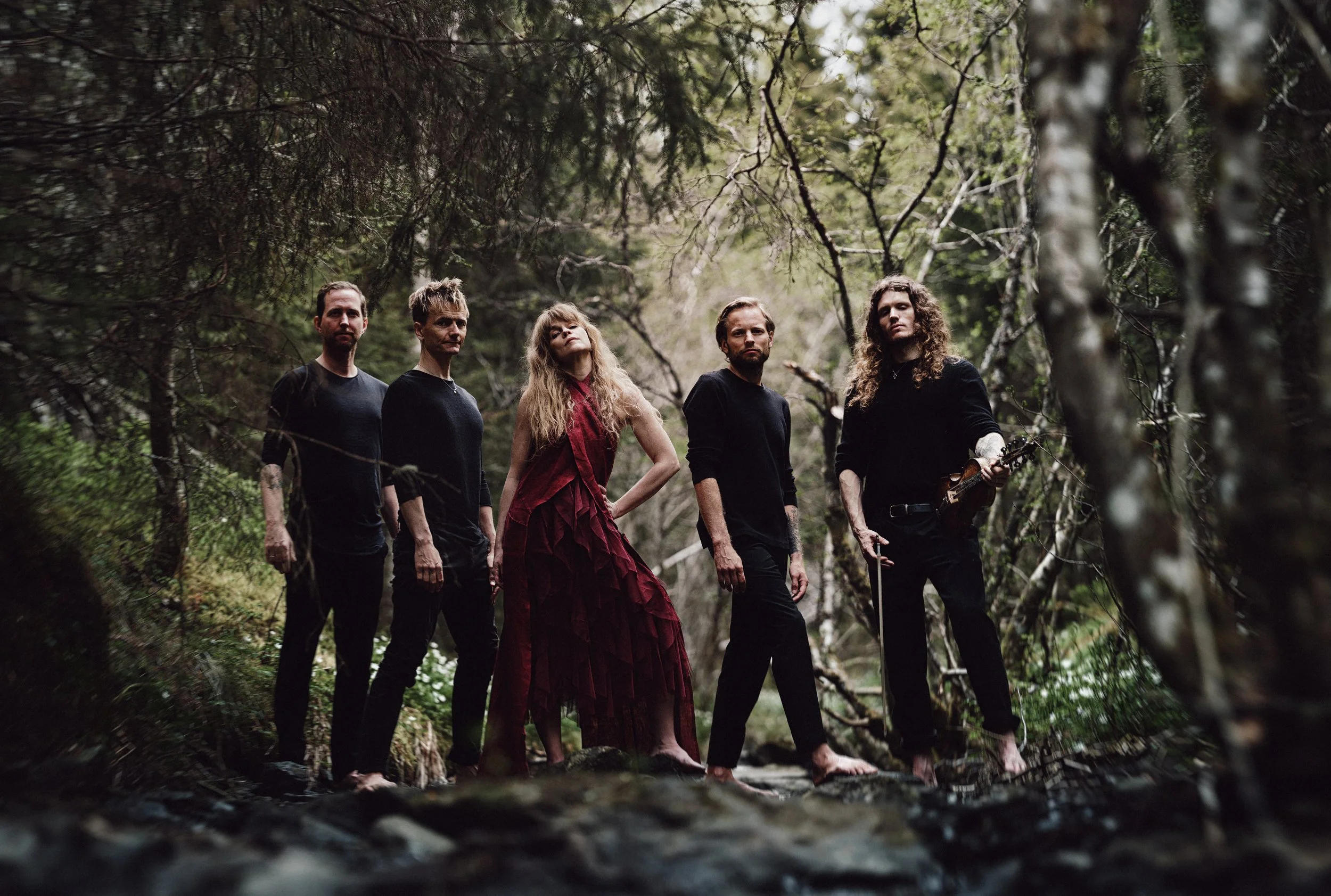
Photo courtesy of Ole Ekker
What are some myths and themes that come through the most on Sigil?
Børmark: The really prevalent one—which also stretches out the canvas for the whole album—it’s one of the songs in the beginning called “Oskorsreia,” which is the Nordic folklore's take on the Wild Hunt. Are you familiar with the Wild Hunt?
I'm not! Can you tell me more about it?
Børmark: So that's a mythical phenomena that is quite prevalent in many cultures. In the Norse version of it—it's around Christmastime—there will be this raging cloud in the sky filled with ghouls and ghosts and dead horses, and it's just a cloud of incessant vulgarity and perversities, and they're all driven by this insatiable hunger. As a human being, if you're out and about at nighttime, and the wild hunter, Oskorsreia, as it's called in the north, you can be very easily seduced into that and just be trapped in this cycle of insatiable hunger. It's quite a vulgar display, and it's very seductive.
We deemed that very relevant for today, because we have the digital wild hunter, the digital Oskorsreia when we're, for example, doomscrolling and with algorithms that put human beings in a state of wanting more and more and more, but never being satisfied. And so that is the amazing effect: this is all relevant. There's always a relevancy to those big myths or archetypical stories, that they will always be relevant in some way. That's [all] about the Wild Hunt. That’s a snapshot of where we are today. We are really seduced, and Oskorsreia is really feasting in 2026. So that is one of the big myths that we also feel is very relevant in contemporary times as well.
And then, of course, that leads to an apocalyptic rise in the dramatic arc, culminating in the next-to-last song, which is “Mi Jord,” which means “my earth,” which is a simple song—not a simple song, but it's a very powerful but vulnerable song about the soul of the earth taking her four last breaths manifested as winds from all directions: north, south, east and west. And that's just her leaving. So there's no anger, there's no nothing. She just leaves the earth. It's just too much, we have to deal with it ourselves now. So, yeah, that's two of the themes we are exploring.
What inspired you to recontextualize these old myths and share them with a contemporary audience?
Børmark: Well, Gunnhild, I would start with you, and your singing as well, from childhood.
Sundli: I started [singing] because I grew up in a family with parents that were very interested in Norwegian folk music. We are three siblings and our childhood was mostly about—like some go do sports and some do classical music and some do other things, but we did Norwegian folk music and traveled around and visited the music festivals with Norwegian folk music and learned to play fiddle, mostly, in a traditional way.
But I remember I discovered my voice when I was around 8, 9, and then I heard this traditional way of singing called kveding, and I asked my mom if I could go and learn. And she found me a teacher and then I got more interested in that than fiddle play. And then I also was very [drawn] to these stories and these myths and… I have always been [drawn] to the past. When I was a little girl, the old days, I wanted always to hear stories about it, and imagine how the world was and how they lived.
And then when I got more into the teenage years, I discovered a band called Garmarna, a Swedish folk rock band. And then I, for the first time, heard that you could make something very different with the tradition I came from and also make it more contemporary and influenced by music that I also listen to. And then that is just what Gåte is about. And it’s in its DNA: taking something old and [taking] it out and [using] it like a platform or inspiration to make something new and make it also relevant for today. And also we have mostly in our career, we have used original traditional material. But more and more, we explored that we could be more inspired from it, but make new stuff. And then this album is actually the first album that is all new [songs].
Børmark: Yeah, every song gets its message or atmosphere or theme from either a known mythical phenomena, or a legend or a tale. So we discovered, as you said, we could take it further by using our own words and just being true. The most important thing is that there actually is feeling or something emotional or something that touches something that is beyond the words.
Sundli: Yes, but it's still rooted in something old.
That makes me curious: you represented Norway for Eurovision in 2024. What was that experience like, and was the song “Ulveham” an original song or a traditional folk tune?
Børmark: That's actually a very good example, because that was an old Middle Age ballad that had many verses, like 20, 30 verses, and then we had a song that was 7 min long. And for Eurovision—or for the Norwegian finals—we just took the song, and we selected some of the verses and we applied, and then we won the whole thing. But then there was a big calamity around us not having written the lyrics ourselves. And we responded, “Yeah they are a thousand years old. That's part of our project. We actually use gems from our shared cultural history and bring it up in modern times.”
But then we’re just, “Okay. Then let's rewrite the lyrics, then.” So, right in the last week before the finals, we rewrote the lyrics, just changing some words, and we actually discovered that we managed to create a much more coherent representation of the actual tale that was being told, and much less fragmented. So it was then deemed as an original lyric, and we had a more coherent story that actually represented the original tale in a much better fashion. And also, with Eurovision, purely musically speaking, making a song that is seven minutes long and making that into a three minute long song, you have to sacrifice quite a lot. And being forced to really stay true to what's essential to a song and what's ornamental, really, and what is really telling something. And this goes for elements in the song, and of course, the structure of the song.
And that has been very inspirational for the songwriting afterwards as well. Like, don't just write long songs because you can. Is the song really there for that long, [or] is this a song that actually deserves to be cut to the bone so you have some living essence there going on for the duration of the time of the song then. So, we can still write long songs, but I think we learned quite a lot about just not just [playing] to play stuff, or just like, “La la la,” let this thing go [on] for minutes and minutes just because we can. It’s more like, “Okay, do we have a connection here? Is there something going on? Do we feel connected to something? Is something being told? Does it feel alive? Is there anything here?” And if not, it just goes. We’ve become much more ruthless there in the songwriting.
And for the whole experience of attending, we were really proud of Norway sending us there because we were not an act, we didn't write this song for Eurovision. We just cut down on an already made song, and we're really proud that they sent something really unusual in a Eurovision context. And we met thousands of people. I mean, before the finals, we traveled around Europe and met this remarkably loving crowd of misfits and outcasts and all these weird, beautiful people that make out the whole community there. And we were superstars in a way you almost never are in our career. That was a really, really blessed experience.
That sounds like such an amazing, transformative experience! What are your live shows like? If I were to go to one of your shows tomorrow, what would that experience be like for me?
Børmark: I can say from our European tours that we've done, that there's always someone crying in the crowd. And people are really listening properly, and they can't understand the lyrics, but it feels like—for us on the stage—that they're really listening with their heart. It's a very dynamic set, so it's a lot of songs with a lot of high energy and jumping around and everything, and Gunnhild will—
Sundli: It's very physical.
Børmark: Yeah, it's physical, yeah.
Sundli: It’s physical, and I think it's like a theatrical experience. We try to make it not just a concert, but also a more theatrical experience.
Børmark: And [as] opposed to making records, [playing] live is where it truly happens, because in this day and age, people in the room meeting up and creating that experience together—like the whole people in the crowd and the band—that's where the real connection happens, and where the magic really happens, because then you’re singing and that connection there just happens there and then, and then it's gone. But after every concert, we are all a little bit different. We have experienced something. And I would say that Gåte is truly a novelty of a live band. I think it's just something you would remember if you were attending a concert—which I hope you will, by the way!
I hope so too! Now that you’ve signed with Season of Mist, do you have any plans to tour more internationally outside of Europe?
Børmark: No tour is made yet, but I reckon we will do festivals in Europe and let's see what shows up, really, abroad.
Sundli: Well, what we’ve experienced is that we have a lot of interest coming our way now. We feel that we are reaching an audience out there that's very curious and interested in our music, and I just have a very strong feeling… for Gåte to play more outside of Norway in the future because people are discovering it.
Y'all have a very special thing going on with your mission and your sound, so I really hope the project keeps expanding.
Børmark: Thank you very much!
Sundli: Thank you. And because of you, it also expands. Because of people like you, and that's so nice to experience that now, that there are a lot of people that want to talk to us because they have listened to the album. I feel that they have discovered something, and that they are curious, and that… this is something they want to check out more. And that's a good thing to experience.
Børmark: Really, we're not taking that lightly. It just really means a lot to us. So, thank you!
Of course! Anything you would like to promote?
Børmark: We sell our merchandise, we sell our physical vinyls and CDs online, so you’re welcome to get some of the first prints there, because I know that it will be changed. The ones that are out now are special for this epoch. More than anything, please listen to the album in its entirety. That would be something we would definitely recommend and ask people to do. Just listen to the whole thing through.
This interview has been minimally edited for clarity.
You can find Gåte on streaming platforms such as Spotify and Bandcamp, and on social media platforms like Instagram.
